Meet Jasdeep Singh Degun
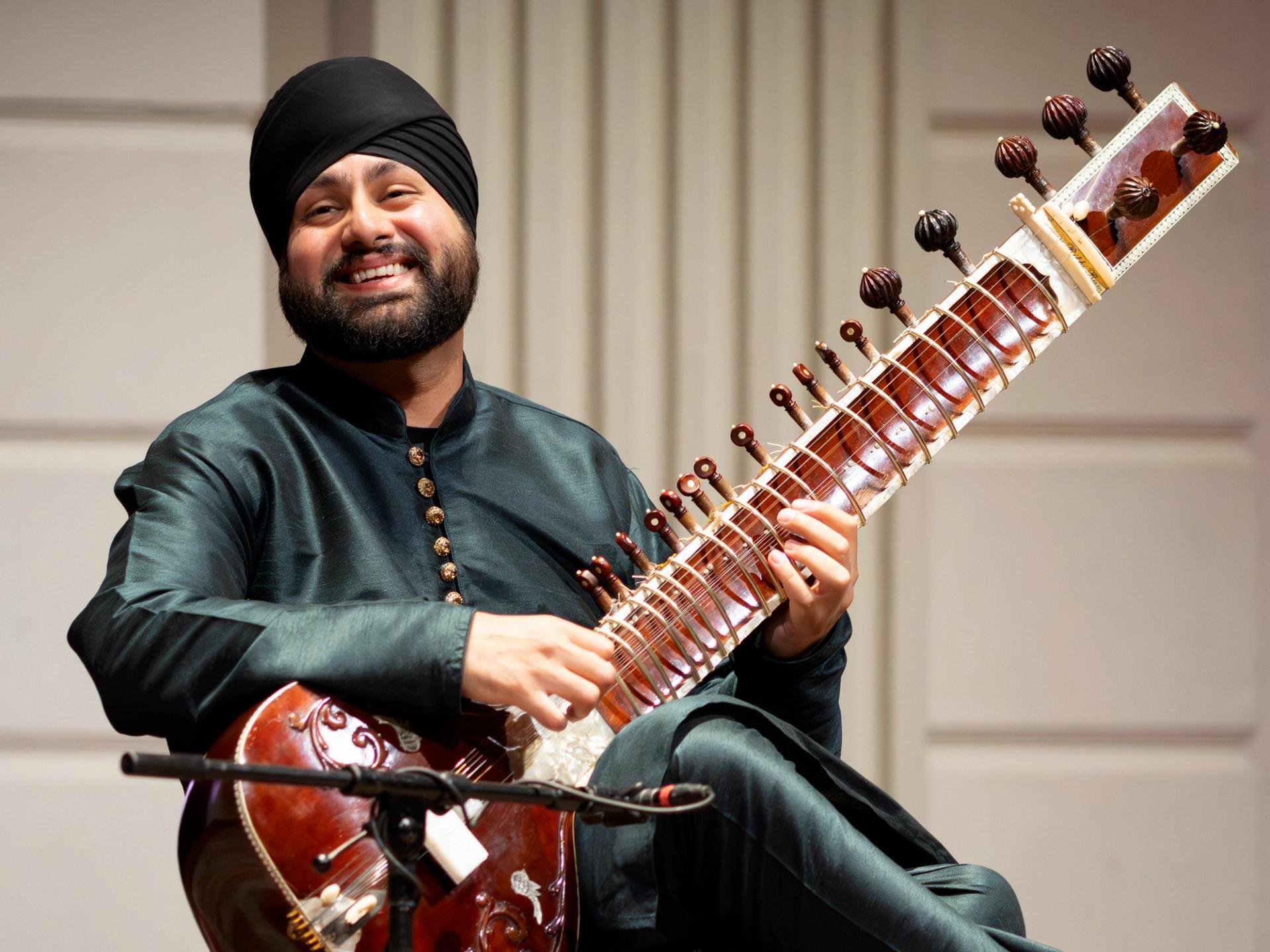
Composer and sitarist Jasdeep Singh Degun returns to CMF on 1 December, with a quintet of the UK’s finest Indian classical musicians. We asked him how performing in an ensemble compares to playing solo and what factors influence the decision about what to play – sometimes just as the concert begins! Hear Jasdeep and friends on 1 December at West Road Concert Hall
When you’re playing as a soloist you have to inspire yourself. But having really good musicians next to me, I can be inspired by their creativity
Raag is often described as ‘unfolding’ – what does that mean?
A raag is a melodic framework on which we improvise. There are hundreds of raags that we learn as musicians – they’re based on very technical and virtuosic elements but allow us freedom to take it where we want to go on the night. The specific scales and phrases for a raag are the thread that ties it together and allows the music to gradually unfold as it’s performed, like a story that flowers as you tell it. Every raag performance is unique – my take on it will be completely different to someone else’s because it’s based on what I feel at that moment.
So what helps you decide on what raag you will play, do you plan it before or decide on the night?
I usually decide in the days leading up to the performance. However, I’ve had concerts where I’ve spent the whole week at home practising a particular raag, only to arrive at the soundcheck on the day and find that something just doesn’t feel right. I don’t feel as fluid or free in that particular space, at that particular moment. On those occasions, I’ve changed the raag for the concert, and the performance has been much better as a result. I think as humans we do take in the environment around us and respond to it, so sometimes what you plan to play doesn’t necessarily turn out how you’d expect it to – but that’s the beauty of Indian classical music!
A certain phrase might open up a new tangent and you can disappear down a rabbit hole to explore before returning – and that’s the beauty of improvisation.
Does that still work when there are five of you on stage?
If I was doing a solo concert (with tabla), I wouldn’t necessarily discuss the choice of raag with the tabla player beforehand. Having five of us on stage does take away a bit of that freedom – we will have to decide on a raag beforehand. The composition we base the performance on is ‘fixed’, we’d all decide on the raag before choosing which compositions we’ll play. Then from there it’s up for grabs. We’ve all trained in the structure (start with the Alaap, then go into the Composition, we get faster then finish with the Jhalla) which is the skeletal premise of any concert. But the real beauty is that we don’t know what’s going to happen, who’s going to play what. We’ll feed off each other in the moment and see how it goes. A certain phrase might open up a new tangent and you can disappear down a rabbit hole to explore before returning – and that’s the beauty of improvisation.
The audience will see us communicating on stage – it’s a very gestural way of performing. There’ll be a lot of interaction and appreciation of each others’ music. When you’re playing as a soloist you have to inspire yourself. But having really good musicians next to me, I can be inspired by their creativity and it will spark something I wouldn’t have even thought of in a solo performance. It’s like we’re all using the same ‘grammar’ but with our different instruments we create something new together. It’s actually quite rare to have the opportunity to play even in duos and trios as it’s a solo tradition, so I’m really looking forward to this concert as quintet.
What is the sitar’s role in a raag?
The sitar is a bit like a vocalist – although it’s a plucked instrument it can emulate vocal nuances, for example by pulling the string over a five-note range to create an effect like a voice or a bowed instrument sliding up or down a scale. Whereas the santoor (hammered dulcimer) is a percussion instrument for the rhythmic side of raag. So each musician is exploring the vast range of what raag can be, using the capabilities of their own instrument.
Which musical figure, past or present, would you most like to have the chance to play with?
I’d be too scared to play with my idols! I’d much rather just have the chance to sit with them and ask them all my burning questions! The person I’d love to meet the most is my teacher’s teacher – Usted Vilayat Khan – the Godfather of sitar playing.
Appearing with Jasdeep on 1 December (clockwise from top left): Gurdain Rayatt, Harkiret Singh Bahra, Kaviraj Singh & Kirpal Panesar